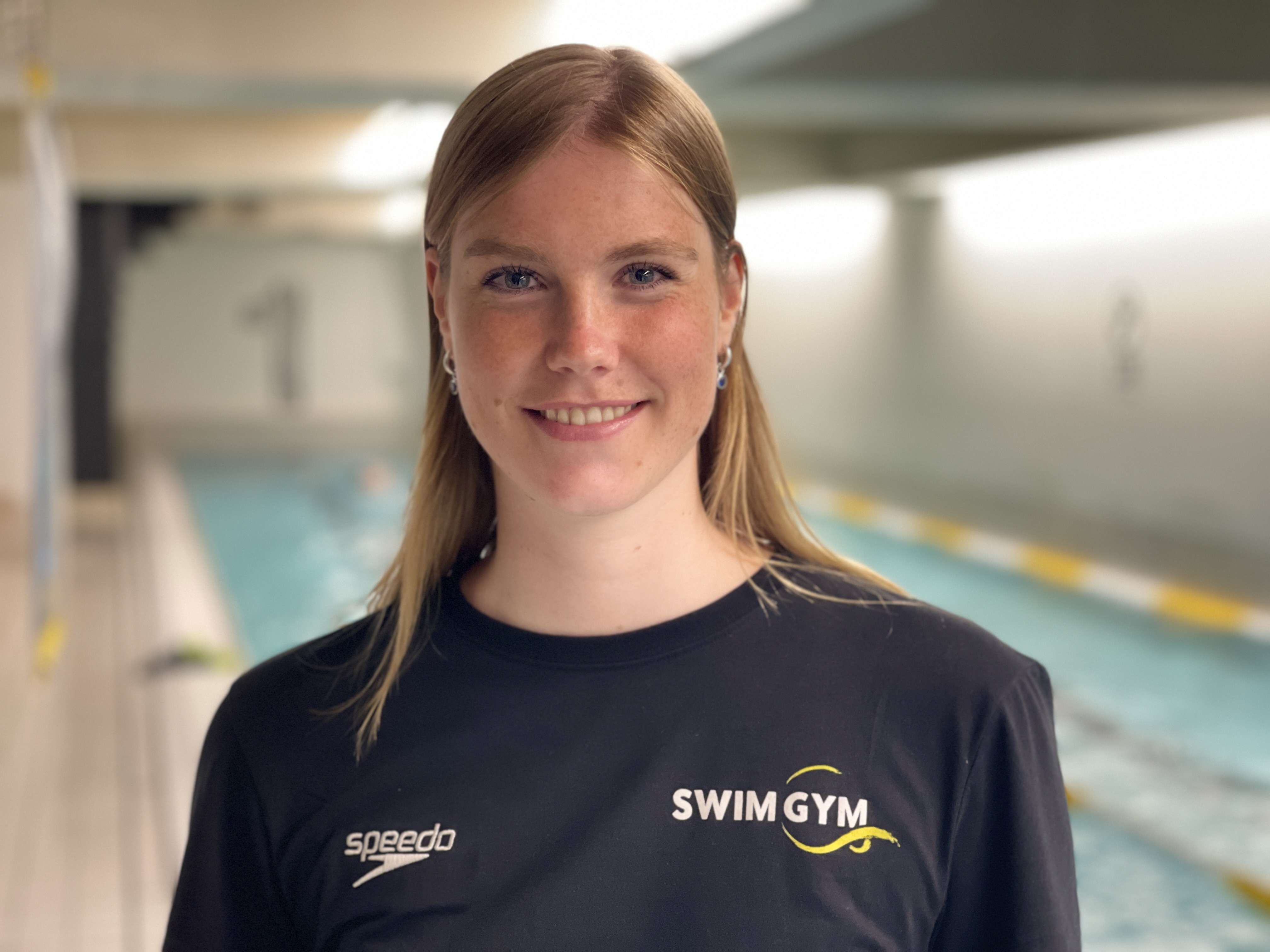
Practiced with · eleven sessions · Amsterdam, 2026
Final edit in progress
The elbow connects to the opposite hip, and suddenly the core is pulling too.
From the first session, Kaylee was working on the head — and it took a long time. In swimming, rotation begins with a head that stays still and looks down while the rest of the body turns around it; without that foundation, the other layers have nothing to build on. Like a good ballet teacher giving the one cue that's missing — straight leg in a tendu, not a correction of everything at once — she would find the simple thing: keep the head lower, don't lift before breathing. Everything else arrived as a deeper layer. The hips, the mid-back, the elbow, the armpit, the timing between arms: each felt complete until a new depth opened. What she kept giving me were precise cues that pointed to the right layer at the right moment. Attend to it, and the stroke organised itself.Where to train in Amsterdam — the city guide →
Kaylee De Jong is a SwimGym coach in Amsterdam whose cues consistently quiet the stroke: a lower, still head; relaxed shoulders; rotation led from throughout the back from the hips up through the shoulders so the elbow lift happens as a consequence, not a shrug. The result is a swim that feels less like arm effort and more like whole-chain timing — breathing becomes simpler, recovery becomes lighter, and glide shows up without being forced.
The first session was about the head. Not a list of things to fix — one thing: the head needed to stay still, looking down, while the rest of the body rotated around it. I understood this as a concept. Understanding it in the water took much longer. What I remember from that first session is not a breakthrough but a reorientation: all the corrections I had been trying — rotation, elbow, timing — were downstream of something I had not stabilised yet. Kaylee gave me the layer that everything else was waiting for.
When the elbow fell below the hand after entry, I could not feel it happening — but I could feel the consequences: a flat stroke, effort without drive, arms carrying what should be shared load. Once Kaylee named it and I could track the sensation of the elbow position, something changed downstream: the line of force from elbow to opposite hip became accessible. The core engaged — not because I activated it, but because the connection was present. The first time I felt the arms contributing without carrying the whole stroke, the movement had an engine under it rather than just effort on top.
Opening the armpit was another shift that arrived immediately. Above water, "high elbow" had been tightening my arm for months. The armpit cue changed the tone at once — the hand landed at shoulder width without a fight, and the crossover that showed up with fatigue reduced. Then, weeks later, high elbow underwater finally made sense. As a result, not a command.
In butterfly with fins, the second kick landed differently — I could feel it completing the push before the arms needed to do anything. With "thumbs down", the recovery opened forward on its own. The arms stopped carrying the stroke; they followed it. That sensation transferred immediately to freestyle: for the first time, arm recovery felt effortless rather than managed.